 |
George H. Smith's
headstone at Old Gray Cemetery.
|
In
Part 1, I established that George H. Smith was not in fact a firefighter with
the Knoxville Fire Department, but rather a prominent businessman. In 1876,
Smith operated a jewelry store on Gay Street in the heart of the business district
and owned numerous properties throughout the city. He had gone from an
outsider, who, like many before and after him, became an insider, establishing social
connections to the city's elite and acquiring additional wealth by marrying
into one of Knoxville's first families. Moreover, he brought energy and a
vision to invest capital into an antebellum town surrounded by untapped
potential in the form of natural resources—the
promise of a burgeoning city on the verge of greatness in the Appalachian
South.
Born in London, England in 1828, his family came to the
United States and settled in New York while he was a young boy. He came of age
in the "Empire State," entered into the jewelry profession, and
married Annie M. Wintermute (see image 2—Annie
is buried next to the Smith family marblestone), who bore him a son. In 1859,
Smith uprooted his family and ventured south to the Queen City of the Mountains
as one of the last waves of northern and foreign-born migrants to arrive in
Knoxville before the Civil War.
 |
Smith family plot at
Old Gray Cemetery, Knoxville. Smith's headstone is far right.
|
The 1850s marked an increase in Knoxville's ethnic
diversity revealed in the 1860 census as the foreign-born made up 22% of the
city's free adult male population. While many townspeople may have found this
trend disturbing as the majority of these newcomers were overwhelmingly poor
and unskilled, several of these immigrants, such as Smith, would come to
dominate Knoxville's postwar commercial and political affairs.
Smith prospered as Knoxville experienced a commercial
boom beginning in 1868 that lasted until a national recession—the Panic of 1873—slowed,
but did not halt, the city's remarkable economic growth. Smith acquired
considerable property throughout the city and built his home at the corner of
Walnut and Asylum (see pink arrow on 1871 map of Knoxville). A devout Christian
man, Smith and his family attended St. John's where he was an active member of
the Protestant Episcopal Church. He also was a member of the Masonic fraternity
holding the titles of "Worthy Master" and "Past High
Priest" of a local chapter (note the Masonic iconography on the Smith stone).
Annie died in 1871. Although grief stricken, Smith soon
found love with another woman, twenty-one years his junior, also named Annie.
Smith's marriage into the Ramage family was typical of many wealthy outsiders
before him, which solidified a union between Knoxville's native and non-native
elites. This bond among elites survived the Civil War, which divided many townspeople
lower on the socio-economic ladder, and was an instrumental factor in
Knoxville's rapid postwar economic growth as locals enthusiastically welcomed a
newer generation of Yankees from Ohio and New York especially, who brought with
them, like a generation before, much-needed energy, a vision of a New South,
and, most importantly, deep pockets as they arrived in the late 1860s. Smith's
second marriage produced a second son who was three years old on the morning of
December 20, 1876 when his father suddenly awoke to the terrifying sound of the
ringing of a fire bell.
Again, over time, accounts of Smith's
active involvement with the fire department as a concerned citizen who not only
advocated for the purchase of modern firefighting apparatus, but also answered
the alarm bell became blurred as the city gradually transitioned from a
voluntary fire department in the1870s and early 1880s into a professional paid
fire department in 1885. As such, many Knoxvillians in the late nineteenth and
early twentieth century simply referred to Smith, who died fighting a December
1876 blaze, as the city's first fallen firefighter. What soon became a
"fact" was subsequently published and republished in newspapers and
books. Hence, today you will find Smith's name on the Bell Buckle memorial to
the state's fallen firefighters as the first casualty among Tennessee's smoke
eaters.
What
happened 141 years ago today is a tragic story. Tragic for the death of a
prominent Knoxville merchant, husband, and father, but also an eye opening
warning that went largely unheeded by city fathers that they needed to bolster
their firefighting defenses in a rapidly expanding Gilded Age mountain city.
What follows is a portion of a first
draft that was written for chapter 2 of Knoxville's Million Dollar Fire, which
traces the evolution of Knoxville fire department:
A blast of cold
arctic air preceded the 1876 winter solstice by a day as the mercury fell below
twenty degrees in Knoxville. While most
of the townspeople slept, the East Tennessee, Virginia, and Georgia Railroad depot
was a busy hub of activity at half past two on the morning of December 20. The railroad’s passenger train number four
was departing as a small army of men loaded and unloaded a score of freight
cars that stood on the tracks underneath the elevated Gay Street bridge. Meanwhile, the watchman at Burr and Terry’s
lumber yard observed the bustling activity from his vantage point a block
directly east of the depot. Each
arriving and departing train represented the only break in his monotonous
routine of keeping a watchful eye on things around the yard. Suddenly he heard a loud cracking and
bursting noise from Allison and McClung’s warehouse which adjoined Burr and
Terry’s lumber yard alongside the tracks.
Upon closer examination, he found a bright flame that appeared to
emanate from the rear of the building.
Startled to see the advertised fireproof brick warehouse ablaze, the
watchman hastened to sound the alarm.
The fire gained significant ground before the alarm, relayed by word of
mouth, reached City Hall, the site of the fire alarm bell and the bulk of Knoxville's
firefighting apparatus. In short order,
the bell at City Hall announced the arrival of an industrializing city’s
greatest fear—the fire-fiend.
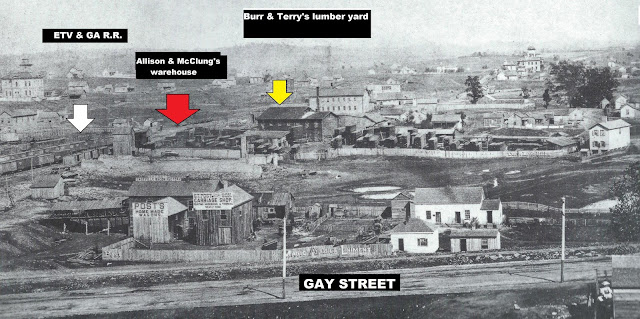 |
1872 photograph (McClung Historical
Collection) looking northwest across Gay Street. The site of the fire (Allison
& McClung's warehouse) is marked by the red arrow. However, the warehouse
was not built until 1875. First Creek is visible behind and to the right of
Burr & Terry's lumber yard. This is where the J.C. Luttrell, the city's
lone steamer, was stationed to fight the fire. The open field to the south of
Allison's & McClung's warehouse is where the Circus and matches of base
ball were played in the early to mid-1870s after development along the 300 and 400
blocks of Gay Street put an end to base ball in Knoxville on its original
grounds.
|
Suddenly the
terrific peals of the fire bell awoke the silence. Aroused from their slumbers, a number of
citizens raced from their homes to the scene of the fire. For a country deep in the throes of its
second industrial revolution, marked by an extraordinary series of
technological innovations, most municipal voluntary fire departments, which
were organized to safeguard their communities from devastation and economic
ruin, failed nationwide to keep pace with the rapid process of
urbanization. Thus lacking the means to
sufficiently combat fires that burned with regularity in densely built urban
areas and threatened both lives and property, the combustible Americans cities
of the nineteenth century required a massive response in firefighting
capacity. Fire was the responsibility of
citizens of all stripes. Thus merchant
princes and clerks, professional men and unskilled laborers alike, threw aside
whatever they were doing as soon as the fire bell tolled and raced to the scene
of the fire with their leather water buckets (municipal laws required every
property owner to keep two buckets filled with water at all times) or joined
teams to help pump the machines of the hand-drawn era of fire engines.
George H. Smith, prominent
businessman and property owner, did not hesitate for a moment to answer the
alarm as he leaped from his bed and hastily dressed himself. It was not at all uncommon to find Smith, an
active leader in the community, on the front lines fighting a fire. Firefighting not only demonstrated one’s
masculinity by testing their strength, courage, and speed, but also enabled
wealthy men to establish their civic virtue by exhibiting their leadership
capability. Smith was among the foremost
advocates of augmenting Knoxville’s firefighting efficiency. He frequently attended municipal meetings and
signed petitions to press city fathers to purchase the latest equipment and
repair any damaged apparatus. From time
to time, he even contributed out of pocket to help defray the costs for such
expenses and compensated voluntary firefighters for their bravery and
service. Smith grabbed his winter coat
and kissed his young bride goodbye as he stepped out on to his porch and
bundled against the biting cold.
 |
Knoxville, 1871 map (Library of
Congress). For context, yellow arrow lower left is the University of Tennessee.
Blue and white arrows centrally located indicates the present day sites of the
Tennessee Theater and Market Square respectively. The pink arrow at the corner
of Walnut and Asylum is where George Smith resided on the morning of December
20, 1876. The red arrow, is the site of the fire and the black star indicates the location where Engineer David Newman stationed the city's lone steam fire engine to draw water from First Creek.
|
Arriving at the
scene of the fire, Smith quickly surveyed the situation. Allison and McClung’s warehouse was
completely engulfed as flames flared and twisted angrily up into the night
sky. Various machinery, produce, and
other combustible materials stored inside the warehouse fueled the blaze. Across the open field that hosted itinerant
circuses and base ball matches, David Newman, the able engineer of the J.C.
Luttrell, stationed the city's lone steamer, a nearly ten year old Silsby fire
steam engine, along the bank of First Creek on Crozier Street so that he had an
available source of water to feed his engine.
But it would take time, as much as ten to fifteen minutes under the most
favorable conditions, before Newman could throw a solid stream of water at high
pressure on the fire. Moreover, the
department’s three hand engine companies struggled in the frigid conditions as
pipes froze solid thereby rendering the bulk of the city’s firefighting
apparatus impotent.
Col. Hugh Smith
then arrived on the scene and, as the owner of the largest quantity of goods
stored in the burning warehouse, assumed charge of directing efforts to salvage
any materials in and around the warehouse.
The conditions were much too dangerous to send anyone inside; therefore,
the Colonel dispatched small teams to clear a train of cars that stood on the
tracks in front of the warehouse. While
most of the cars were empty, burning embers landing near one coal filled car
threatened to ignite its combustible cargo.
George Smith and his team was tasked with rolling this car to a safe
distance down the track. As the men took
hold of the car, Smith stepped on the side of the track nearest the
warehouse. All of a sudden, a low and
distant rumble of thunder shook the ground.
A frightening cry sounded almost simultaneously. “The wall is falling!” The warning came too late for Smith. Trapped between the burning inferno and the
railroad car, he had nowhere to run once the brick wall, expanded by the fierce
heat, crackled and crumbled outward.
Hundreds of bricks rained down, burying Smith beneath a pile of crushing
debris. Dozens of hands immediately pitched
in to clear the mass of brick and mortar before them thus revealing Smith’s
lifeless body so covered in dust that he was not recognized until the jeweler’s
longtime friend Edward Jackson Sanford arrived on the scene and confirmed his
identify.
 |
Present day site of the fire (to the
right of the tracks). Photograph taken on the Gay Street viaduct looking
northwest.
|
Before the smoldering ruins
of Allison and McClung’s warehouse had cooled, a cluster of influential
reform-minded citizens began to advocate for a commonsense approach to combat
fire and improve Knoxville’s fire protection.
A comprehensive report of the fire and an assessment of the voluntary fire
department revealed that it was woefully unprepared to protect Knoxville
against a massive conflagration. The key
findings of the report emphasized the department’s slow response time and outdated,
faulty equipment. Knoxville had failed
to modernize its fire defenses in light of an ever-changing and expanding urban
landscape.
The delay in the fire department’s
response exposed an inadequate system of alarm.
In an industrial age in which most urban fire departments had long
adopted fire alarm telegraph systems developed in the 1850s to more accurately
pinpoint the scene of a fire, Knoxville continued to rely on preindustrial
methods of alarm used since colonial times.
That most residents first learned of imminent danger from the tolling of
the city hall bell contributed to the slow response. Calls to repair the cracked bell that many
Knoxvillians on the outskirts of town claimed they could not hear had been
ignored for nearly five years. Despite recommendations
to purchase a modern telegraph alarm system, city leaders buried further
discussion in committee and justified their inaction in light of the lingering
regional and national recession. Another
twelve years passed before the city fathers approved the purchase of a modern
electric alarm system.
A second warning revealed by
the deadly fire concerned Knoxville’s antiquated fire apparatus. Although the fire department’s lone steamer
had performed admirably in arresting the flames in challenging conditions, the subfreezing
temperatures highlighted shortcomings of the voluntary fire department's hand-operated
fire engines. Whereas most cities made
the transition to steam prior to the Civil War and never looked back, Knoxville
city government had recently opted to purchase a third hand engine in favor of
another expensive and occasionally fickle steam fire engine. This bold decision, driven by fiscal probity,
ignored appeals from the fire chief, business leaders, and reformers for a
second steamer to help cover an expanding metropolis. The new fire apparatus that city fathers
christened the “Reliance” failed to live up to its name as it, and the other
two low pressure hand engines, proved counterproductive in inclement weather. Once more the city council balked and fell
back on habitual remedies. The city
fathers hedged their bets on a less costly solution to fire protection and
approved the purchase of four hundred feet of new hose. Moreover, they reorganized the department in
the hope that it would prove more efficient in answering future alarms.
The piecemeal response on the
part of Knoxville’s leaders revealed all the harbingers of trouble to come. All
too often, the clear warning signs of impending disaster were either dismissed
in the name of fiscal responsibility or ignored, swept under the rug of
borrowed time. Conservative boosters and
like-minded members of the press were notorious for constructing an alternate
script that glossed over the city’s outdated firefighting apparatus and the
destruction wrought by fire. Rather,
these stories emphasized individual acts of heroism and bravery—such as George Smith.
In the days that followed the
fatal fire of 1876, Knoxville’s city fathers, merchant princes, and the press
followed the same pattern of response to fire first exhibited by the town’s
pioneer settlers. This elite group
extolled the virtue and skill of its firefighters and their lone steamer, which
prevented the spread of fire and thus safeguarded lives and additional
properties. They focused their narrative
on a celebration of George Smith’s life, his civic virtue, and selfless
bravery. Smith’s heroism embodied the
classical republican notions of disinterested public service that nineteenth
century Americans had come to attribute to its political leaders as well as
voluntary and professional firemen. His
death, albeit tragic, represented a noble sacrifice to protect and secure the
lives and property of others. With each
new telling and retelling, Smith the jeweler filled with voluntaristic public
spirit who raced headfirst into danger without a moment’s doubt to assist the
fire department fight infernos blurred into Smith the fireman.
A close reading between the lines
of this narrative, however, revealed all the hazards to Knoxville connected
with fire. Be that as it may, the
warning signs eroded with the passage of time and a lack of devastating fires. A collective amnesia soon descended once
again over Knoxville, wiping out memories of the dangers posed by inadequate
fire protection as residents were lulled into a false sense of security. The fire-fiend was neither an infrequent
visitor nor did it discriminate between rich and poor as it consumed shanty
dwellings and two and three-story brick storehouses alike. But the fact that Knoxville remained
relatively small and spread out for much of its history minimized the potential
for catastrophic fires that consumed several blocks of residences and
businesses in many larger nineteenth century American industrialized
cities. The townspeople’s good fortune
bred complacency and a general lackadaisical attitude towards the enforcement
of fire codes.
A dangerous cocktail of
collective amnesia, complacency, and a general lackadaisical attitude towards
fire safety reform, while Knoxville's dense, urban landscape grew alarmingly, generated
the volatile environment that fueled Knoxville's Million Dollar Fire.
noxvillians in the early twentieth century simply
referred to Smith as the city's first fallen firefighter and what became a
factoid was subsequently published and republished in newspapers and books.
Hence, today you will find Smith's name on a Bell Buckle, TN memorial as the
first casualty among Tennessee's smoke eaters.
Here is a little narrative of the events that transpired 140 years ago in the
early hours of December 20, 1876:
A blast of cold arctic air preceded the 1876 winter solstice by a day as the
mercury fell below twenty degrees in Knoxville. While most of the townspeople
slept, the East Tennessee, Virginia, and Georgia Railroad depot was a busy hub
of activity at half past two on the morning of December 20. The railroad’s
passenger train number four was departing as a small army of men loaded and
unloaded a score of freight cars that stood on the tracks underneath the
elevated Gay Street bridge. Meanwhile, the watchman at Burr and Terry’s lumber
yard observed the bustling activity from his vantage point a block directly
east of the depot. Each arriving and departing train represented the only break
in his monotonous routine of keeping a watchful eye on things around the yard.
Suddenly he heard a loud cracking and bursting noise from Allison and McClung’s
warehouse which adjoined Burr and Terry’s lumber yard alongside the tracks.
Upon closer examination, he found a bright flame that appeared to emanate from
the rear of the building. Startled to see the advertised fireproof brick
warehouse ablaze, the watchman hastened to sound the alarm. In short order, the
bell at the city hall announced the arrival of an industrializing city’s
greatest fear—the fire fiend.
Suddenly the terrific peals of the fire bell awoke the silence. Aroused from
their slumbers, a number of citizens raced from their homes to the scene of the
fire. For a country deep in the throes of its second industrial revolution,
marked by an extraordinary series of technological innovations, municipal fire
department services developed to safeguard communities from devastation and
economic ruin failed nationwide to keep pace with the rapid process of
urbanization. Lacking the means to sufficiently combat fires that burned with
regularity in densely built urban areas and threatened both lives and property,
the combustible cities of the nineteenth century required a massive response in
firefighting capacity. Fire was the responsibility of citizens of all stripes.
Thus merchant princes and clerks, professional men and unskilled laborers threw
aside whatever they were doing as soon as the fire bell tolled to carry buckets
of water or join teams to help pump the hand-drawn era of fire engines.
George H. Smith, a prominent businessmen who owned a jewelry store and held
title to considerable property throughout the city, did not hesitate for a
moment as he hastily dressed and kissed his young bride goodbye. It was not at
all uncommon to find Smith, an active leader in the community, on the front
lines fighting a fire. Firefighting not only demonstrated one’s masculinity by
testing their strength, courage, and speed, but also enabled wealthy men to
establish their civic virtue by exhibiting their leadership capability. From
time to time Smith joined Knoxville’s volunteer fire department and took the
lead on increasing the city’s firefighting apparatus. Smith grabbed his winter
coat and rushed out of his home located at the corner of Walnut and Asylum. As
he bundled against the biting cold, Smith could faintly see the J.C. Luttrell,
the fire department’s lone steamer, pulling out of its headquarters at the
north corner of Market Square. The horse-drawn Silsby steam engine raced
northward in the direction of the railroad. The forty-eight year old jeweler
took off on foot taking the most direct route to save time and thus making
great strides until his pace was slowed as he ascended a hill between Reservoir
and Vine. Once Smith crested the hill he could see a thick black column of
smoke billowing and flames bursting through the roof of one of the warehouses
along the railroad tracks below him. He carefully descended down the steep
hill, made more treacherous on a moonless night and slick, icy conditions.
Arriving on the scene, Smith quickly surveyed the situation. Allison and
McClung’s warehouse was completely engulfed as flames flared and twisted
angrily up into the night sky. Various machinery, produce, and other
combustible materials stored inside the warehouse fueled the blaze. Across the
open field that hosted the circus and base ball matches, Smith could see David
Newman, the able engineer of the J.C. Luttrell, station the steamer along the
bank of First Creek on Crozier Street so that he had an available source of
water to feed his engine. But it would take time, as much as ten to fifteen
minutes under the most favorable conditions, before Newman could throw a good
stream on the fire. Moreover, the department’s hand engine companies struggled
in the frigid conditions as pipes froze solid thereby rendering the bulk of the
city’s firefighting apparatus impotent.
Col. Hugh Smith then arrived on the scene and, as the owner of the largest
quantity of goods stored in the burning warehouse, assumed charge of directing
efforts to salvage any materials in and around the warehouse. He dispatched
small teams to clear a train of cars that stood on the tracks in front of the
warehouse. While most of the cars were empty, burning embers landing near one
car filled with coal threatened to ignite its combustible cargo. George Smith
and his team was tasked with rolling this car to a safe distance down the
track. As the men took hold of the car, Smith stepped on the side nearest the
house. With his back to the warehouse, he pushed with all of all his strength.
All of a sudden, a low and distant rumble of thunder shook the ground. A
frightening cry sounded almost simultaneously. “The wall is falling!” The
warning came too late for Smith. Trapped between the burning warehouse and the
railroad car, he had nowhere to run once the brick wall, expanded by the fierce
heat, crackled and crumbled outward. Hundreds of bricks rained down, burying
Smith beneath a pile of crushing debris. Dozens of hands cleared the mass of
brick and mortar before them revealing Smith’s lifeless body so covered in dust
that he was not recognized until the jeweler’s longtime friend Edward Jackson
Sanford confirmed his identify.The first name that appears on the Tennessee
Fallen Firefighters Memorial is George H. Smith of Knoxville's Fire Department
who perished in a warehouse fire 140 years ago tomorrow morning.


